
For CROs & VPs of Sales
Hit Your Number Without Rebuilding Strategy Every Quarter
CROs and VPs of Sales at mid-market B2B SaaS companies use AgileGTM® OS to align their revenue org on a single strategy, ramp new AEs faster, and walk into competitive deals with evidence-backed displacement arguments — without a dedicated RevOps team to hold it together.
Why scaling revenue is harder than it should be for CROs and VP Sales
You own the number, but the systems around you — disconnected tools, inconsistent ICPs, stale competitive intel — are working against you every single quarter.
Every rep runs a different ICP
Without a single documented ICP, each rep targets whoever they think fits. Pipeline fills with mismatched accounts, cycles stretch, and forecast accuracy collapses.
Competitive losses you can't diagnose or prevent
Reps improvise objection handling because battlecards are a quarterly slide deck — stale, uncited, and ignored. You lose winnable deals to rivals your team wasn't prepared for.
New AE ramp eats 60–90 days of quota capacity
There's no documented, strategy-grounded playbook to hand a new rep on day one. Onboarding is tribal knowledge transfer — slow, inconsistent, and expensive every single hire.
The cost of inaction: Every quarter without a shared ICP, current competitive intelligence, and a repeatable playbook is a quarter where your team is selling at a fraction of its potential — and you're defending missed targets to the board with gut feel instead of data.
These aren't execution problems. They're system problems — and the spreadsheet-and-deck workflow that created them can't fix them.
How AgileGTM® OS helps CROs and VPs of Sales build pipeline from a strategy that actually holds
The approach
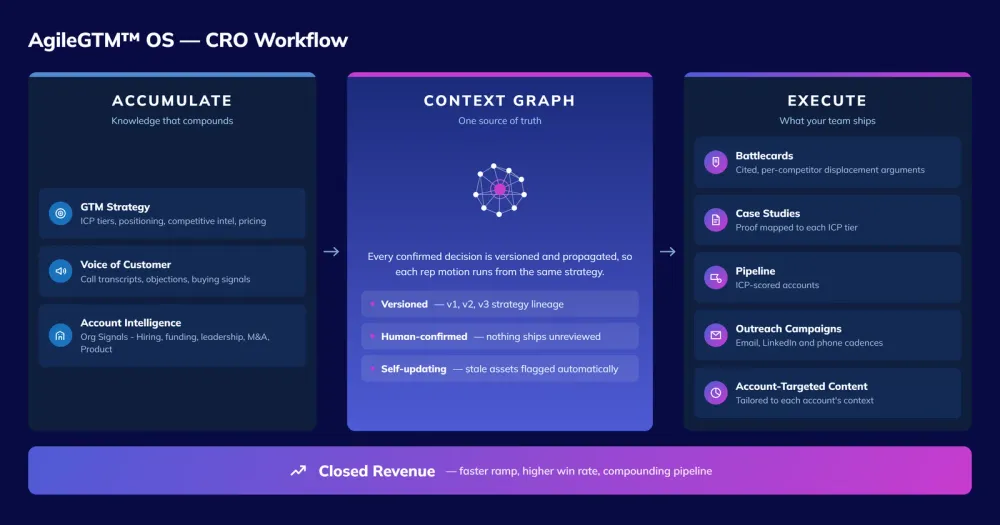
- One strategy source of truth: the Context Graph accumulates every confirmed ICP, positioning, and competitive decision, so reps always pull from the same data — not last quarter's deck.
- Evidence-backed competitive plays: battlecards cite real G2, Capterra, and TrustRadius review data — displacement arguments your buyer can't invalidate in the first five minutes.
- Per-deal competitive play surfacing: the platform generates a deal-specific one-pager in under 60 seconds when a competitor is involved in an opportunity — no library navigation required.
- ICP-aligned pipeline from day one: Apollo.io integration surfaces contacts scored against your defined ICP tiers, with account signals — hiring, funding, leadership changes — used as outreach hooks.
- Signal-informed outreach sequences: multi-channel cadences (email, LinkedIn, phone) are generated from ICP tier data and live account signals — not generic templates your buyer ignores.
- Positioning changes propagate automatically: when strategy is updated and confirmed, every downstream asset — sequences, battlecards, sales decks — is flagged and queued for bulk regeneration in one action.
- Call intelligence feeds the strategy: 4-lens transcript analysis writes structured buyer voice back into the same Context Graph your reps work from.
- Human-confirmed before it ships: no AI output writes to the shared knowledge base until a human explicitly approves it — so a bad assumption never silently corrupts an active sales deck.
The result is a revenue team that enters every competitive deal with current, cited intelligence — and never loses a quarter to a positioning update that took three weeks to reach the field.
Built for how CROs and VP Sales actually work
AgileGTM® OS gives you the strategic infrastructure your revenue org needs — from ICP alignment and competitive readiness to pipeline building and rep ramp — without adding headcount or weeks of cross-functional meetings.
ICP Definition That Sales and Marketing Both Own
Synthesizes four to eight deduplicated market segments with scored ICP tiers — giving every rep and campaign the same qualified target, not competing interpretations.
Evidence-Backed Competitive Displacement Arguments
Profiles competitors across 14 attributes with gap analysis cited from G2, Capterra, and TrustRadius — so reps enter every deal with a prepared, credible counter, not improvised objection handling.
GTM Readiness Dashboard — One Shared Scorecard
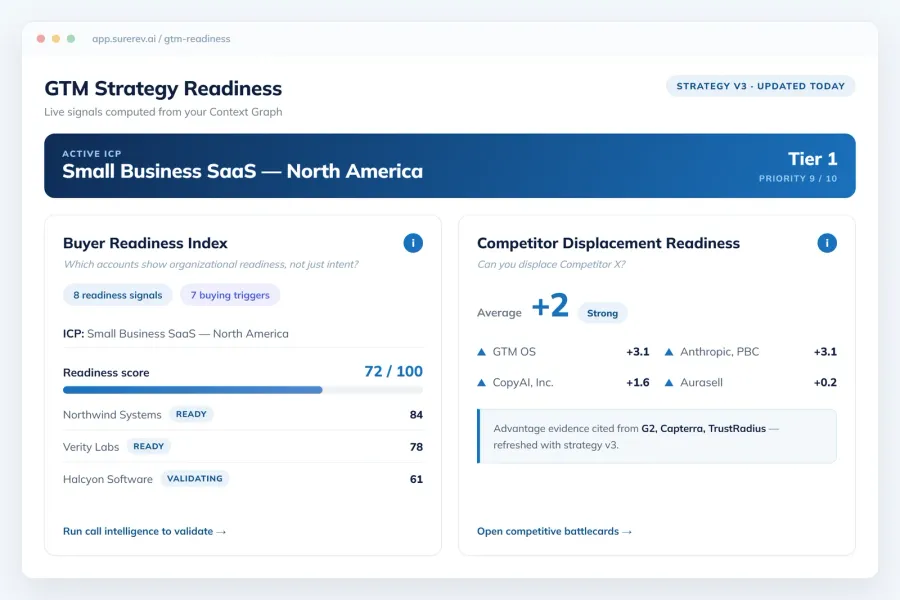
Five live cross-functional signals — Positioning-Market Fit, Buyer Readiness, Competitive Displacement Readiness, Capability Gap Priority, and Price-Value Alignment — computed from a single data layer, continuously, so you always know where the gaps are.
ICP-Aligned Pipeline Builder with Account Signal Detection
Integrates with data providers to surface contacts matching your scored ICP, and continuously monitors account-level buying signals — hiring, funding, M&A, product launches, partnerships, and leadership changes — so your team prospects into accounts that are ready to buy.
Signal-Informed Outreach Cadences Across Three Channels
Generates email, LinkedIn, and phone scripts with timing and sequencing logic — personalized to your ICP tier and grounded in the account signals your pipeline builder is already detecting, replacing generic sequences with context-aware hooks.
Strategy-Grounded Sales Content — Always Current
Generates battlecards, sales decks, one-pagers, pricing memos, and email sequences from the same strategy data layer — and flags every document automatically when the underlying strategy changes, so reps never carry stale collateral into a deal.
Every capability feeds the same Context Graph, so a change to your ICP or competitive positioning ripples through your pipeline targeting, outreach cadences, and sales content without a single manual update.
What CRO and VP of Sales teams achieve with AgileGTM® OS
The numbers above are grounded in the platform's designed workflow outcomes — and the fastest way to pressure-test them against your own pipeline and ramp targets is to see the system in action.
From zero to live pipeline in 4 steps
No ops team required. AgileGTM® OS guides you through each step — so you spend your time reviewing decisions, not building infrastructure from scratch.
- 1
Define your ICP and segment your market
AgileGTM® OS synthesizes four to eight market segments and generates two to three scored buyer personas per segment — complete with titles, pain points, buying triggers, and disqualifiers. You confirm what's right, and the platform locks it into the Context Graph as your shared source of truth, so every downstream output — from battlecards to outbound cadences — is built on the same foundation.
- 2
Map your competitive position and pricing
The platform profiles seven to 15 competitors across 14 attributes, cites gaps from G2, Capterra, and TrustRadius, and scores three positioning paths across 10 weighted dimensions — so you walk into board conversations with evidence, not opinions. Pricing architecture follows immediately: a market-anchored price corridor, a four-tier structure, and a revenue sensitivity model you can export to Excel.
- 3
Build and qualify your pipeline
AgileGTM® OS connects to data providers like Apollo.io and searches for contacts using your confirmed ICP criteria. Account-level readiness signals (hiring, funding, M&A, leadership changes, product launches) surface in real time, so your reps prioritize accounts that are more likely to buy.
- 4
Launch signal-informed outreach and track readiness
Multi-channel cadences — email, LinkedIn, and phone scripts — are generated from your ICP definition and live account signals, with detected signals used as opening hooks. The GTM Strategy Readiness Dashboard then gives you five live cross-functional signals (including Buyer Readiness Index and Competitor Displacement Readiness) so you can see, at a glance, whether your team is ready to close — and where the gaps are.
Time to value: Most CROs and VP of Sales complete Steps 1 through 3 — confirmed ICP, competitive position, and a qualified prospect list — in a single working session. Live outreach cadences and a populated pipeline are ready before your next team standup.
Once your strategy is live in the Context Graph, every new call transcript, account signal, and rep conversation feeds back in — keeping your GTM motion sharp as your market moves.
Questions about AgileGTM® OS for CROs and VP of Sales
How does AgileGTM® OS help a CRO or VP of Sales align the entire revenue org on a single GTM strategy?
AgileGTM® OS solves the alignment problem at the data layer, not the meeting layer. The platform's Context Graph acts as a single, structured knowledge base where every confirmed strategy decision — ICP definition, positioning, competitive intelligence, pricing — is written once and shared across all downstream outputs. When Sales and Marketing are both pulling from the same versioned source of truth, the "which ICP are we targeting?" debate stops happening in Slack and starts being answered by the system.
The GTM Strategy Readiness Dashboard makes alignment measurable. Five live cross-functional signals — including Positioning-Market Fit and Competitor Displacement Readiness — are computed from the same Context Graph, so you can see in real time whether your revenue org is operating from a coherent strategy or drifting apart. For a CRO managing a lean team without dedicated RevOps, this replaces weeks of cross-functional meetings with a shared scorecard everyone can see.
My reps are losing competitive deals because they improvise objection handling. How does AgileGTM® OS fix that?
AgileGTM® OS generates evidence-backed, per-competitor displacement arguments grounded in review-site-cited gap analysis — not internal opinions. The competitive intelligence module profiles competitors across 14 attributes each, pulling verified weaknesses from G2, Capterra, and TrustRadius. That evidence feeds directly into battlecards and sales decks generated by the Content Studio, so every rep enters a competitive deal with the same structured, credible argument rather than improvising from memory.
The Competitor Displacement Readiness signal on the dashboard gives you a live, per-competitor advantage score so you can see exactly where your team is prepared and where they're exposed — before a deal is lost. For a VP of Sales who's been watching the same competitor win deals quarter after quarter, this is the difference between a reactive post-mortem and a proactive playbook.
New AE ramp takes 60 to 90 days because we have no documented GTM playbook. Can AgileGTM® OS fix that?
Yes — and this is one of the highest-leverage use cases for a CRO running a lean team. AgileGTM® OS generates a complete, strategy-grounded GTM playbook from the Context Graph, including ICP definitions with tier scores, buyer personas with pain points and buying triggers, competitive battlecards, objection handlers, and multi-channel outreach cadences. A new AE can access all of this on day one rather than spending 60 days absorbing tribal knowledge from the founder or a senior rep.
Because every document is generated from the same structured strategy data and flagged automatically when that data changes, the playbook stays current without anyone manually maintaining it. That means your second and third AE hires ramp from the same living document as your first — not from a Notion wiki that was last updated eight months ago.
We already have HubSpot, Notion, and a few other tools. Why do we need AgileGTM® OS on top of that?
HubSpot manages your pipeline and Notion stores your documents — but neither of them generates your GTM strategy, keeps it current, or connects it to your outreach and content. The problem most CROs describe isn't a lack of tools; it's that their tools don't talk to each other at the strategy layer. Reps pull from a Notion doc that's months out of date, Marketing runs campaigns against a different ICP than Sales is targeting, and no one has a single view of whether the strategy is actually coherent.
AgileGTM® OS sits above your existing stack as the strategy operating layer — generating the ICP, positioning, competitive intelligence, and playbooks that feed into HubSpot, Outreach, and your content workflows. It's designed to replace the spreadsheet-and-deck workflow that currently lives between your strategy decisions and your execution tools, not to replace the execution tools themselves. For teams without dedicated RevOps or a PMM, it fills the gap that those hires would otherwise cover.
How do I know the AI-generated strategy outputs are accurate enough to defend in front of the board or in a pricing conversation?
AgileGTM® OS is built around a human-in-the-loop principle: nothing persists to the Context Graph until you explicitly confirm it. Every strategy step — ICP definition, competitive profile, pricing corridor, positioning path — requires your review and sign-off before it propagates downstream. You're not approving a black-box recommendation; the platform exposes its reasoning through a separate Reasoning Output panel so you can see exactly how a conclusion was reached before you confirm it.
For pricing specifically, the platform computes a market-anchored price corridor using three distinct anchors — a cost-based floor, a competitor median, and a value-based ceiling — extracted from real competitive research rather than internal estimates. That's the kind of structured, sourced evidence that holds up in a board conversation or an investor pricing discussion, where "we benchmarked against the market" needs to mean something specific and defensible.
My team doesn't have time to learn a new tool mid-quarter. How disruptive is the onboarding process?
AgileGTM® OS is designed as a guided, sequential workflow — not a blank canvas that requires configuration before it produces value. You start by describing your product and market, and the platform's AI agents do the research, synthesis, and generation work from there. Most CROs and VP of Sales who use the platform describe the first session as producing usable strategy outputs — ICP definitions, competitive profiles, positioning options — rather than requiring a setup phase before anything useful appears.
The platform compresses what would otherwise be three to four weeks of cross-functional strategy meetings into a structured workflow that runs in hours. For a revenue leader mid-quarter, that means you can run a GTM strategy refresh without pulling your team out of selling time — and the outputs are immediately usable in your existing tools rather than requiring a migration or workflow change to get value.
What measurable results should a CRO or VP of Sales expect from AgileGTM® OS in the first 90 days?
The outcomes most directly relevant to a CRO or VP of Sales in the first 90 days cluster around three areas. First, ICP alignment: a single, documented ICP definition adopted across Sales and Marketing — measurable by eliminating the "which accounts are we targeting?" conflict that currently surfaces in pipeline reviews. Second, competitive readiness: per-competitor displacement arguments embedded in battlecards and sales decks, so reps stop improvising and start winning more of the deals where a competitor is named. Third, rep ramp acceleration: a documented, strategy-grounded GTM playbook that new AEs can onboard from on day one rather than absorbing tribal knowledge over 60 to 90 days.
Beyond those three, the platform's pricing architecture module gives you market-anchored data to defend pricing tier decisions to the board — replacing gut feel with a structured corridor analysis. And the GTM Strategy Readiness Dashboard gives you a live view of whether your revenue org is aligned, so you can identify and correct drift before it shows up as a missed quarter. These are the outcomes AgileGTM® OS is purpose-built to deliver for a CRO running a lean team without dedicated RevOps or a PMM.
How is this different from just using Claude Code or Claude Cowork to generate strategy and content?
General-purpose AI tools like Claude Code or Claude Cowork are excellent at generating content, but they don't govern what becomes your canonical GTM strategy. AgileGTM® OS enforces a hard confirmation gate — no AI-generated ICP, positioning, or competitive argument becomes part of your strategy or reaches a battlecard until a human explicitly approves it. Every confirmation is logged in an append-only audit trail showing who approved it and when, visible in a version history view your team can point to — the kind of record that holds up in a board conversation or enterprise procurement review, not just a chat transcript.
Because every asset traces back to one Context Graph, a strategy change also automatically flags every downstream battlecard, sequence, and deck as stale, so nothing silently goes out of sync across your revenue org. General AI tools govern how content gets generated; AgileGTM® OS additionally governs what becomes canonical strategy and what breaks when it changes.
Ready to close more competitive deals — without chasing your team for updates?
CROs and VP of Sales at mid-market B2B SaaS companies use AgileGTM® OS to equip every rep with current, evidence-backed competitive intelligence, keep positioning consistent across every deal, and cut competitive loss rates — all without a dedicated RevOps function. See exactly how it fits your motion.