
One Context Graph.
Your Entire GTM, Aligned.
Go from GTM strategy to execution in 30 minutes.
AgileGTM® OS is the AI Strategy Operating System for B2B GTM teams — grounding every ICP, positioning, and sales decision in one versioned Context Graph, so strategy cycles compress, cross-functional drift disappears, and every downstream asset stays in sync.
What B2B revenue teams are likely to accomplish with AgileGTM® OS
Trusted by 100+ Founders, GTM and Marketing execs, MBA programs.
“By utilizing SureRev.ai’s advanced AI-powered platform, Identity Plus was able to gain valuable insights into our potential customers, their needs, and their pain points… We used the platform iteratively during the customer discovery to keep alignment from strategy through messaging.”
“SureRev has supercharged the productivity of my GTM consulting work in ways beyond what I expected—adding best-practice processes and signals to my analysis while letting me incorporate my own intel.”
“SureRev streamlines GTM work, helping me quickly define ICPs, sharpen positioning, and refine messaging. The platform simplifies competitive analysis and differentiation.”
“SureRev AI dramatically speeds up early research, competitive intelligence, positioning & messaging work, saving 40–60 hours of effort. I would recommend it to marketing teams.”
“So far, this is the best I have seen in the market for my clients.”
“I had the opportunity to use SureRev AI in the final semester of my MBA Program at Babson College. We were introduced to this tool in our Selling & Sales Management course with Professor Vincent Onyemah and I found it useful while developing our go-to-market strategy.
To provide some context, our capstone project, in true Babson fashion, required us to launch a startup. As someone who has never done this before, I embarked on the journey solo and really put myself in an environment where I could learn through making mistakes and iteration. With no experience in “GTM” or some of the other requirements of wearing every hat in the business, there was a lot to digest.
SureRev AI and the founder helped me navigate this challenge. The process is extremely user-friendly and intuitive, and it augmented my learning. The system was instrumental in narrowing down my ICP, something I had been struggling with at the time. The two largest wins for me were being able to take concepts from our classwork and apply them practically and seeing how inputs in one part of the process influenced the downstream strategy.”
How AgileGTM® OS works
- 1
Who is my target market & ideal customer?
- 2
What should I build to satisfy their needs?
- 3
How do I reach them & win deals?
INGEST
Market, competitor, CRM, call data, product data and more
CURATE
Decision engine
PERSIST
The Context Graph — one versioned source of truth for your GTM strategy, voice of customer, target accounts
EXECUTE
Positioning, content, campaigns, pipeline, agent deployment
Your first Context Graph, built free
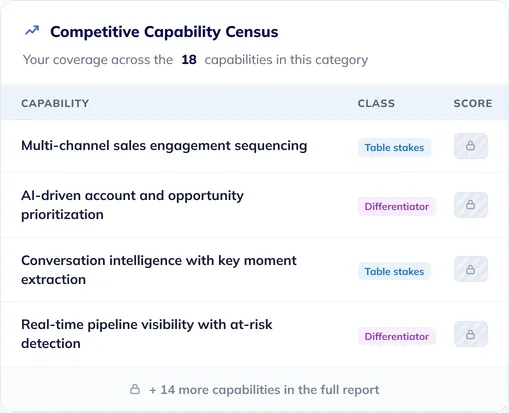
We build a Context Graph for your category and competitors, then hand you the first thing it produces: the Competitive Capability Census, scoring your product against selected competitors on the capabilities that define your category. Each capability is classified as table stakes or differentiator — the same analysis our customers run before they set positioning, built from real competitor evidence, not a survey.
- Your competitive set, mapped — the capabilities buyers actually weigh when comparing you to the competitors you select, not a generic feature list
- Table stakes vs. differentiator — which gaps cost you deals, and which ones nobody scores you on
- Your score vs. theirs — capability by capability, each with a plain-language definition
- Where to invest next — the gaps worth closing first, ranked by competitive impact
Your GTM stack has every tool except a strategy layer
You're running GTM from Notion docs and gut feel
Strategy lives in a wiki last updated eight months ago. Sales, Marketing, and Product each operate from a different version of the truth — and no one agrees on the ICP.
Point solutions give you data but no connected strategy
You have CRM, intent data, and a call recorder — but no layer that connects market signals to positioning decisions. Insights stay siloed; strategy stays manual.
General-purpose AI drafts copy without strategic context
ChatGPT writes fast but cannot tell you why an ICP or competitor is a strategic priority, or how you can win in the market. Every output starts from zero — and none of it compounds into a living strategy.
Strategy refreshes eat weeks your team doesn't have
Quarterly GTM cycles pull leadership into cross-functional workshops for three to four weeks. By the time the deck is final, the market has already moved.
There is a better way — one that connects every GTM decision to a living, structured context graph.
One system where every GTM decision compounds on the last
The GTM Context Graph is the connective tissue — every confirmed strategy step writes to a shared, versioned knowledge base that drives every downstream output automatically.
Curate raw signals into a structured context graph
Call transcripts, CRM records, competitor pages, and product docs don't arrive as strategy — they arrive as noise. A proprietary decision engine parses every source, extracts the entities that matter, and forms them into graph nodes and weighted edges: a capability links to an ICP tier, a competitor gap links to a positioning angle, a buyer signal links to a sales play. The result isn't a document dump your team has to interpret — it's a connected graph your team and your AI agents can both reason over.
Build your GTM brain with the Context Graph
Key strategic inputs and execution steps are written to a structured Context Graph. Every downstream asset — dashboards, documents, campaigns, pipeline — and every agent action computes from one versioned source of truth.
See readiness signals, not five opinions
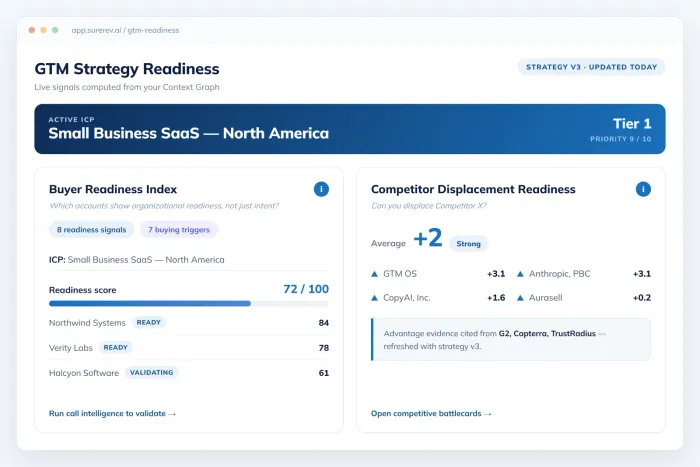
Run the GTM Strategy Readiness Dashboard to surface cross-functional signals. Five scores — Positioning-Market Fit, Buyer Readiness, Competitive Displacement, Capability Gap, and Price-Value Alignment — compute live from the Context Graph.
Profile competitors with cited evidence
Trigger AI-powered competitive discovery to generate 14-attribute competitor profiles. Gap analysis cites G2, Capterra, and TrustRadius directly — not inferred weaknesses your buyer can invalidate in the first five minutes.
Position products using 10 weighted dimensions
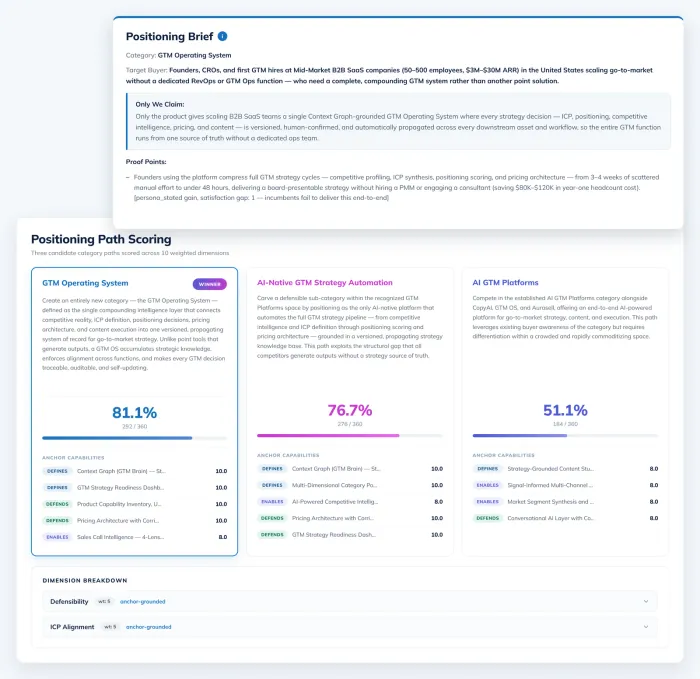
Run the multi-agent positioning engine to evaluate three product positioning paths. A four-tier capability leadership roadmap and a generated Positioning Brief emerge — not a single AI recommendation you have to trust blindly.
Analyze every sales call through four GTM strategy lenses
Upload or sync a call transcript to run 4-lens call analysis. Capability Demand, ICP Validation, Competitive Intelligence, and Market Signals feed directly back into the Context Graph that built your strategy.
Generate unlimited context graph-grounded content that never go stale
Produce battlecards, sales decks, email sequences, and pricing memos from Context Graph data. Staleness detection flags every document the moment underlying strategy data changes — so your team never ships the wrong message.
Built for the revenue leaders who own GTM strategy
For CROs & VP Sales: Cut ramp time and win more competitive deals
Your reps are improvising strategy that should already be documented. AgileGTM® OS gives every AE a Context Graph-grounded playbook on day one.
- Rep ramp: Deliver a strategy-grounded GTM playbook before the first day.
- Competitive readiness: Per-competitor displacement arguments built from cited evidence.
- ICP alignment: One shared ICP definition adopted across Sales and Marketing.
- Outbound reply rates: Signal-aware personalization replaces generic sequences.
- Strategy cycles: Compress quarterly GTM refreshes with team alignment from weeks to under 48 hours.
For VP Marketing: Ship positioning updates in hours, not weeks
Every campaign you run is only as good as the strategy behind it. The Context Graph keeps your ICP, messaging, and content library in sync automatically.
- Positioning propagation: Strategy changes flow to all GTM assets within minutes.
- ICP validation: Test assumptions against real buyer conversation data monthly.
- Positioning scoring: Score three strategic paths before committing campaign budget.
- Content currency: Staleness detection flags outdated assets the moment strategy shifts.
- Sales alignment: One agreed ICP definition eliminates cross-functional escalations.
For Founders & CEOs: Build a board-ready GTM strategy without a GTM hire
You can't be the single source of GTM truth forever. AgileGTM® OS encodes your strategy into the Context Graph so the team executes without you in every decision.
- Strategy speed: Compress GTM planning from six weeks to under one week.
- Board readiness: Produce a defensible GTM strategy without a dedicated analyst.
- Human control: No strategy data persists until you explicitly confirm it.
- Roadmap evidence: Shift prioritization from internal advocacy to ICP-weighted data.
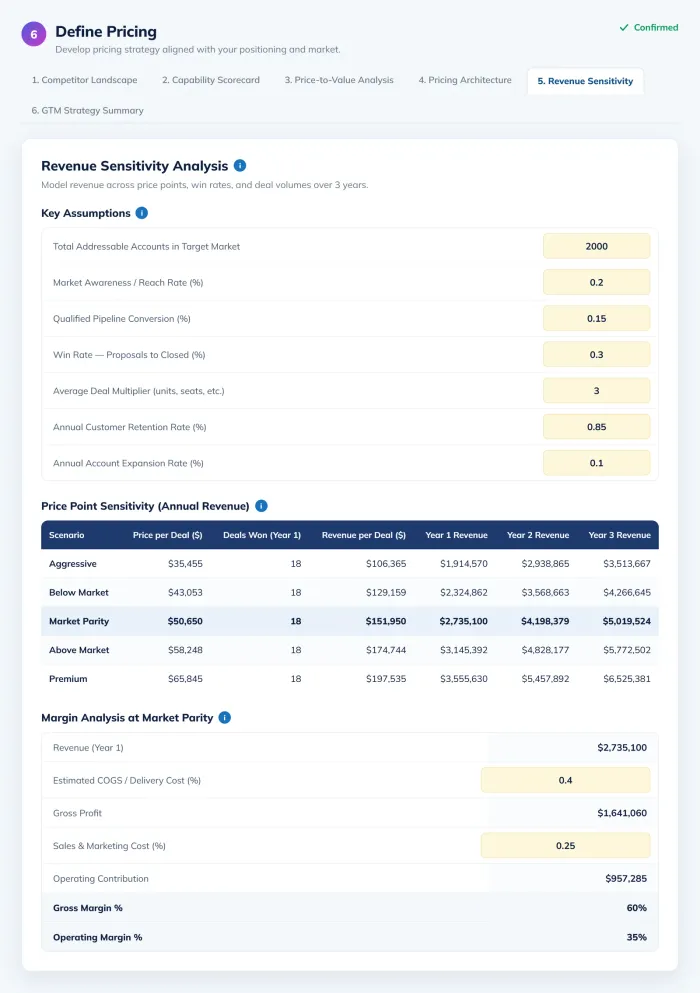
- Pricing defense: Market-anchored benchmarks replace gut feel in investor conversations.
Whichever role you own, the Context Graph keeps your entire revenue org working from the same strategy — not three different versions of it.
Questions buyers actually ask before switching
Honest answers to the skeptical objections we hear most often.
We already use HubSpot and Notion for GTM — why add another platform?
HubSpot executes campaigns and Notion stores documents — both do their jobs well. What neither does is connect your ICP definition to your positioning, your positioning to your competitive intelligence, and all of it to your outbound sequences in a single, continuously updated layer. That gap is where strategy drift lives.
AgileGTM® OS is an AI GTM Strategy operating system built to replace the coordination overhead between those tools, not sit on top of them. The GTM Context Graph keeps every downstream asset — battlecards, sequences, messaging — synchronized to a single strategic source of truth. Most teams find it consolidates three to five point solutions rather than adding to the stack.
We already pay for a competitive intelligence tool — what does this add that we don't have?
Dedicated competitive intelligence platforms do an excellent job of monitoring competitor signals and surfacing battlecard content. The gap is that competitive intelligence exists in isolation — disconnected from your ICP definition, your positioning decisions, and the outreach sequences your reps are running today.
AgileGTM® OS connects competitive intelligence to the rest of your GTM strategy through the GTM Context Graph. When a competitor moves, the displacement argument updates and propagates to your battlecards, sequences, and sales decks automatically — without a PMM manually re-authoring four separate assets. That connected propagation is what standalone CI tools cannot do.
We already use a revenue intelligence platform for call analysis — why do we need this on top?
Revenue intelligence platforms are excellent at surfacing what happened in a deal — competitor mentions, objection patterns, talk ratios. That insight is genuinely valuable. The limitation is that it stays inside the call recording tool and rarely updates the GTM strategy it should be informing.
AgileGTM® OS closes that loop. Buyer conversation signals feed directly into ICP validation and positioning refinement through the GTM Context Graph — so what your reps hear in the field actually changes the strategy, not just the coaching notes. It is the difference between observing drift and correcting it.
We already use an AI writing tool for content and outreach — why pay for a separate GTM AI platform?
AI writing tools are fast at producing copy, and that speed is real. The problem is that the output is only as good as the prompt — and prompts have no memory of your ICP, your competitive positioning, or the strategy decision made last quarter. Every session starts from zero.
AgileGTM® OS is an AI GTM Strategy operating system, not a content generator. The GTM Context Graph encodes your strategy — ICP, positioning, competitive landscape, pricing rationale — and grounds every AI-generated output in that context. The result is content that reflects your actual differentiation, not a generic first draft that needs heavy editing before it can go to a prospect.
How do I know the AI-generated strategy outputs are accurate enough to use in front of the board or in a live deal?
This is the right question to ask of any AI strategy tool. AgileGTM® OS requires explicit human confirmation before any AI-generated output propagates to the team or to customer-facing assets. No strategy change goes live without a named reviewer signing off — creating a full audit trail of what was generated, reviewed, and approved.
The GTM Context Graph also grounds every output in your own strategic inputs rather than generic training data, which reduces hallucination risk significantly. You are not trusting a black box — you are reviewing structured outputs built from the market evidence and positioning decisions you provided.
Our Sales and Marketing teams are already misaligned — won't another tool just add more complexity?
Misalignment usually comes from the absence of a single authoritative source of GTM strategy — not from too many tools per se. Sales operates from one ICP interpretation, Marketing from another, and neither is wrong because no canonical version exists. Adding execution tools on top of that fragmentation does make things worse.
AgileGTM® OS is designed to solve that root cause. The GTM Context Graph establishes one versioned, confirmed ICP definition that both Sales and Marketing operate from. When that definition updates, it propagates downstream automatically — so the misalignment Slack threads stop because there is no longer a question of which version is current.
We're scaling fast — my team doesn't have time to implement a new platform mid-quarter.
Implementation overhead is a legitimate concern, and most GTM platforms underestimate it. AgileGTM® OS is structured as a guided workflow — you input your market context, the AI agents do the research and structuring, and you confirm outputs rather than building from scratch. The first usable GTM strategy output is available in a single session, not after a multi-week onboarding project.
The teams that get the most value are typically the ones mid-quarter who need a defensible ICP or competitive argument fast — not the ones with six weeks to plan. If your team is stretched, that is precisely the condition the platform is built for.
How does raw data actually become a "Context Graph" — is this just an LLM summarizing my documents?
No — summarization and graph construction are different problems, and conflating them is where most "AI knowledge base" tools fall short. When AgileGTM® OS ingests a call transcript, a competitor page, or a CRM record, a proprietary decision engine doesn't just summarize the text — it identifies the specific GTM entities inside it (a capability, an ICP signal, a competitor claim, a buyer objection) and determines how that entity relates to everything already in your graph: which ICP tier it validates, which positioning angle it strengthens or undercuts, which competitor profile it updates.
One Context Graph. Every GTM decision versioned, propagated, and ready to execute.
AgileGTM® OS is the GTM Operating System that replaces your fragmented research tools, spreadsheets, and outbound stack with a single Context Graph-grounded workflow — compressing weeks of manual strategy refresh to minutes, without a dedicated ops team.