
For Founders & CEOs
Run a Full GTM Strategy Without a GTM Team
AgileGTM® OS gives founders and CEOs at scaling B2B SaaS companies a complete, board-ready go-to-market strategy — built by AI agents, confirmed by you, and connected to every downstream asset from day one.
Why building a GTM strategy is harder than it should be for founders
You're running product, fundraising, and sales simultaneously — and the tools you have weren't built for someone doing all three at once with no dedicated GTM staff.
Strategy lives in your head, not a system
Your ICP, positioning, and competitive arguments exist as founder intuition — scattered across Notion docs, slide decks, and ChatGPT threads that no one else can reliably execute from.
Weeks lost every time the market shifts
A new competitor enters, a pricing assumption breaks, or a positioning angle stops landing — and rebuilding the strategy from scratch consumes weeks you don't have before the next board meeting.
Five tools, zero connected strategy
HubSpot, Notion, Apollo, ChatGPT, and Google Slides each hold a piece of your GTM — but none of them talk to each other, so every update requires manually re-propagating changes across all five.
The cost of inaction: Without a documented, repeatable GTM system, every new hire ramps slowly on tribal knowledge, every board conversation requires rebuilding the strategy narrative from scratch, and every market shift costs weeks of founder time that should be going to product and fundraising.
There's a better way to run GTM strategy when you're the one responsible for all of it — and it starts with replacing the spreadsheet-and-deck workflow with a single guided system.
How AgileGTM® OS helps founders run a complete GTM function without a dedicated ops team
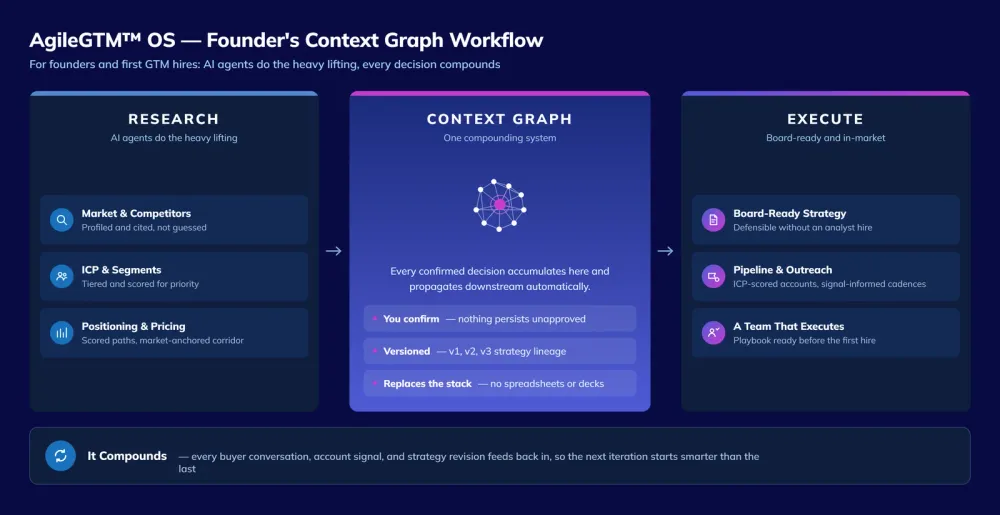
AgileGTM® OS is an AI GTM Strategy operating system that helps founders and first GTM hires at mid-market B2B SaaS companies build and execute a complete, compounding go-to-market strategy — by replacing fragmented research tools, spreadsheets, and outbound platforms with a single Context Graph-grounded workflow where AI agents do the heavy lifting and every decision propagates automatically downstream.
The approach
- One shared source of truth: every confirmed strategy step writes to the Context Graph, so ICP, positioning, competitive intelligence, and pricing all live in one versioned knowledge base — not scattered across decks and docs.
- AI does the research, you make the call: AI agents profile competitors, synthesize 4–8 market segments, and score three positioning paths — then nothing persists until you explicitly confirm it.
- Strategy changes propagate automatically: when you confirm a positioning update, every downstream asset — battlecards, email sequences, campaign playbooks, sales decks — is flagged stale and queued for bulk regeneration in a single action.
- Buyer conversations feed the strategy back: four-lens call intelligence analysis routes capability demand signals, ICP validation data, and competitive mentions directly back into the Context Graph, so assumptions are tested against real conversations monthly.
- Five live readiness signals replace five departmental opinions: the GTM Readiness Dashboard computes Positioning-Market Fit, Buyer Readiness, Competitor Displacement Readiness, Capability Gap Priority, and Price-Value Alignment from the same data — not from whoever argued loudest in the last meeting.
- Unlimited documents generated from strategy, not templates: battlecards, pitch decks, outreach sequences, homepage copy, and more are produced from Context Graph data and stay current as your strategy evolves.
- Human-in-the-loop governance at every step: no AI output writes to the shared knowledge base or propagates to your team without your explicit confirmation — so you move at AI speed without silent errors corrupting active sales materials.
The result is a GTM function that compounds over time — each new buyer conversation, strategy revision, and competitive update makes the whole system smarter — without requiring a dedicated RevOps hire to keep it running.
Key capabilities for founders building GTM without a dedicated team
AgileGTM® OS does the heavy research and strategy work so you can focus on product and fundraising — here is what runs continuously on your behalf.
Living GTM Knowledge Base — Always Current
Every strategy decision you confirm writes into a structured Context Graph, so your ICP, positioning, and competitive data stay connected and never go stale in a forgotten Notion doc.
ICP Definition and Tier Scoring in One Session
AI synthesizes four to eight market segments with two to three detailed buyer personas each — including buying triggers and disqualifiers — scored one to ten so you know exactly where to focus first.
Positioning Paths Scored Before You Commit
A multi-agent workflow scores three distinct positioning paths across ten weighted dimensions — capability fit, competitive density, buyer readiness, and more — so you choose with evidence, not instinct.
Competitive Intelligence That Keeps Updating
AI profiles competitors across fourteen attributes, with gap analysis cited from G2, Capterra, and TrustRadius — so your battlecards reflect today's landscape, not last quarter's.
Board-Ready Pricing Architecture with Market Anchors
Extracts competitor pricing from research, computes a floor-to-ceiling price corridor, generates a four-tier structure, and models revenue sensitivity — giving you defensible numbers for investor conversations.
Human-Confirmed Strategy — Nothing Propagates Without You
Every AI-generated output requires your explicit confirmation before it writes to the knowledge base or flows downstream — keeping you in control of every strategic decision, with a full audit trail.
These capabilities work together as a continuous system — when your market shifts, your ICP data, positioning scores, and content library update together, not in separate quarterly projects.
What Founder and CEO teams achieve
AgileGTM® OS is built on a structured, versioned GTM knowledge graph — an architectural approach with no equivalent in the category. Every strategy output is grounded in your company's own context, confirmed by you before it reaches your team, and traceable to the reasoning behind it. You stay in control of every strategic decision while the platform does the research, synthesis, and documentation work that would otherwise consume your week.
These outcomes reflect the design intent behind AgileGTM® OS — see them in practice by starting your free trial.
From zero to live pipeline in 4 steps
- 1
Define your market and ICP
Answer a few questions about your product. AgileGTM® OS synthesizes 4–8 deduplicated market segments, generates 2–3 detailed buyer personas per segment, and assigns ICP tier scores so you know exactly who to pursue first.
- 2
Run competitive and positioning analysis
AI agents profile competitors across 14 attributes, pull cited gaps from G2, Capterra, and TrustRadius, and score three strategic positioning paths across 10 weighted dimensions. You confirm what's right; everything locks into the Context Graph.
- 3
Generate your GTM documents and outreach playbooks
With strategy confirmed, AgileGTM® OS generates unlimited document types — battlecards, sales decks, pricing memos, email sequences — plus signal-informed multi-channel cadences grounded in your ICP definition and positioning. Every asset is versioned and staleness-flagged automatically.
- 4
Build pipeline and track readiness live
Connect data providers to pull ICP-matched contacts, detect account-level buying signals, and move prospects through a full contact and deal lifecycle. The GTM Strategy Readiness Dashboard computes five live cross-functional signals so you always know where your go-to-market stands.
Time to value: Most founders complete Steps 1 and 2 — market definition, competitive intelligence, and a confirmed positioning path — within a single working session. Live pipeline contacts follow in the same day.
Once your Context Graph is populated, every new document, campaign, and readiness signal updates from the same source of truth — so your GTM stays coherent as your strategy evolves.
Questions about AgileGTM® OS for Founders and CEOs
How does AgileGTM® OS help a founder build a complete GTM strategy without hiring a dedicated GTM team?
AgileGTM® OS is an AI GTM Strategy operating system that helps founders and CEOs build a board-ready GTM strategy — including ICP definition, competitive positioning, pricing architecture, and outbound playbooks — by guiding you through a structured, AI-driven workflow that does the heavy research and synthesis for you. Instead of spending weeks pulling together Notion docs, ChatGPT prompts, and Google Slides into something coherent, you work through a sequential set of steps where AI agents handle market segment synthesis, competitor profiling, and positioning path scoring, and you confirm each output before it locks into the system.
The result is a complete, documented GTM strategy grounded in real market data — not founder intuition — that you can hand to your first AE on day one or present to your board with confidence. Founders using this workflow can compress what would otherwise take three to four weeks of scattered effort into a single focused session, without the cost of a GTM consultant or a premature full-time marketing hire.
We already use ChatGPT for strategy and Notion for documentation — what does AgileGTM® OS add that we can't stitch together ourselves?
ChatGPT and Notion are general-purpose tools. They're great for drafting and storing ideas, but they don't accumulate structured strategy outputs, they don't connect your ICP definition to your outreach sequences, and they don't flag when a positioning change makes your existing battlecards or email templates stale. Every time your strategy shifts, you're manually updating five different documents in three different tools — and something always gets missed.
AgileGTM® OS replaces that fragmented workflow with a single, connected system. Every confirmed strategy step writes into a shared knowledge base — the Context Graph — and all downstream outputs (battlecards, campaign playbooks, sales decks, pricing memos) are generated from that same source of truth. When something changes upstream, the platform flags which documents are now out of date. That's the compounding value you can't replicate by stitching together a general-purpose AI tool with a wiki.
How do I know the AI-generated strategy outputs are accurate enough to trust in front of the board or investors?
Nothing in AgileGTM® OS persists to the system until you explicitly confirm it. Every AI-generated output — whether it's a market segment definition, a competitor profile, or a positioning path score — requires your review and approval before it becomes part of your strategy. This human-in-the-loop design means you're always the final decision-maker; the AI does the research and synthesis, and you validate the conclusions before they propagate downstream.
On the competitive intelligence side specifically, gap analysis cites specific review sources — G2, Capterra, TrustRadius — rather than inferred weaknesses, so you can verify the evidence before presenting it. Pricing architecture uses three distinct anchors: a cost-based floor, a competitor median, and a value-based ceiling, giving you a defensible structure rather than a single number pulled from thin air. The goal is to give you the confidence to say "here's the data behind this decision" — not to hand you a strategy to rubber-stamp.
My team doesn't have time to learn a new tool mid-quarter — how disruptive is the onboarding process?
AgileGTM® OS is designed to be founder-operable from the first session. The workflow is sequential and guided — you're not configuring a platform, you're answering structured questions and reviewing AI-generated outputs. Most founders complete their first full GTM strategy pass, including ICP definition, competitive landscape, and positioning, in a single focused working session rather than across weeks of cross-functional meetings.
There's no data migration required, no CRM integration needed to get started, and no dedicated ops person needed to maintain it. If you're currently running your GTM strategy out of Notion and Google Slides, you can start using AgileGTM® OS today and have a structured, documented strategy output by end of week — without disrupting anything your team is already doing mid-quarter.
I don't want AI making strategic decisions for my company without my oversight — how does AgileGTM® OS handle founder control?
Founder control is a core design principle, not an afterthought. AgileGTM® OS operates on a strict human-confirmation model: the AI generates, you decide. No strategy output — ICP definition, positioning path, pricing structure, competitive argument — is locked into the system or propagated to downstream documents until you explicitly confirm it. You can review, edit, or reject any AI-generated output before it becomes part of your strategy.
The platform also maintains a full append-only audit trail of every confirmed decision, so you always have a clear record of what was decided, when, and on what basis. If you want to run multiple positioning scenarios before committing, the system scores three distinct paths across ten weighted dimensions so you can compare options rather than defaulting to the first recommendation. You stay in the driver's seat throughout — the AI handles the research and synthesis so you can spend your time on judgment, not on manual work.
We're too early-stage for a platform like this — should we just hire a Head of Marketing first?
That's a reasonable instinct, but the sequencing often works better in reverse. Hiring a Head of Marketing before you have a documented ICP, a clear positioning strategy, and a defined competitive stance means your new hire spends their first 60 to 90 days rebuilding the strategic foundation from scratch — at a fully loaded cost of $80,000 to $120,000 or more in year one. AgileGTM® OS lets you build that foundation first, so when you do hire, your new leader can execute against a documented strategy on day one rather than starting from a blank page.
The platform is specifically designed for companies at the stage where GTM strategy lives in the founder's head and hasn't been formally documented yet. If you have a working product and early paying customers, you have enough market signal to make the ICP definition and positioning work meaningful. The free trial is structured so you can validate that for yourself before committing.
What happens to our proprietary strategy data — who owns it and how is it secured?
Your strategy data belongs to you. AgileGTM® OS encrypts stored credentials with Fernet (AES-128-CBC + HMAC), enforces workspace-level data isolation, and maintains an append-only audit trail of key strategy and platform activity.
Access within your organization is governed by role-based controls at the Owner, Admin, and Member level, with project-level assignment so you can control exactly who sees which parts of your strategy. If you're evaluating AgileGTM® OS ahead of a fundraise or an enterprise sales motion where data security will come up in due diligence, the platform is built to support that conversation rather than complicate it.
Ready to launch your GTM strategy in 48 hours?
You don't need a PMM, a consultant, or another quarter of scattered research. AgileGTM® OS gives you a complete, board-presentable GTM strategy — ICP, positioning, competitive intelligence, and live pipeline — in one guided workflow.