
For Product Marketing Managers
Keep Every GTM Asset Current Without the Manual Rework
AgileGTM® OS gives Product Marketing Managers a single, strategy-grounded system that automatically flags stale content, propagates positioning updates across every asset, and keeps competitive intelligence current — so you can focus on strategy, not maintenance.
Why keeping positioning current is harder than it should be for Product Marketing Managers
You own competitive intelligence, ICP definition, and positioning — but the tools you rely on were never designed to work together, and the gap between strategy and execution widens every week.
Battlecards go stale before reps ever use them
Competitors ship features weekly. Your battlecard refresh cycle is quarterly at best — built manually in Notion, trusted by almost no one on the sales floor.
Strategy changes take weeks to reach the field
A positioning update decided in a leadership meeting still needs to cascade into the sales deck, email sequences, one-pagers, and website copy — all manually, all by you.
Three teams, three versions of the ICP
Sales prospects into one profile, Marketing campaigns against another, and Product prioritizes a third. There is no authoritative ICP — just a Notion doc nobody fully agrees with.
The cost of inaction: Every week the battlecard is stale is a week a rep improvises a competitive response. Every positioning update that takes three weeks to propagate is three weeks of campaigns, sequences, and decks pulling in different directions — and you absorb every hour of the manual rework while the strategy you built keeps drifting further from what the market actually sees.
There is a better way to keep strategy, competitive intelligence, and content permanently in sync — and it starts with replacing the manual propagation loop entirely.
How AgileGTM® OS helps Product Marketing Managers ship strategy that actually sticks
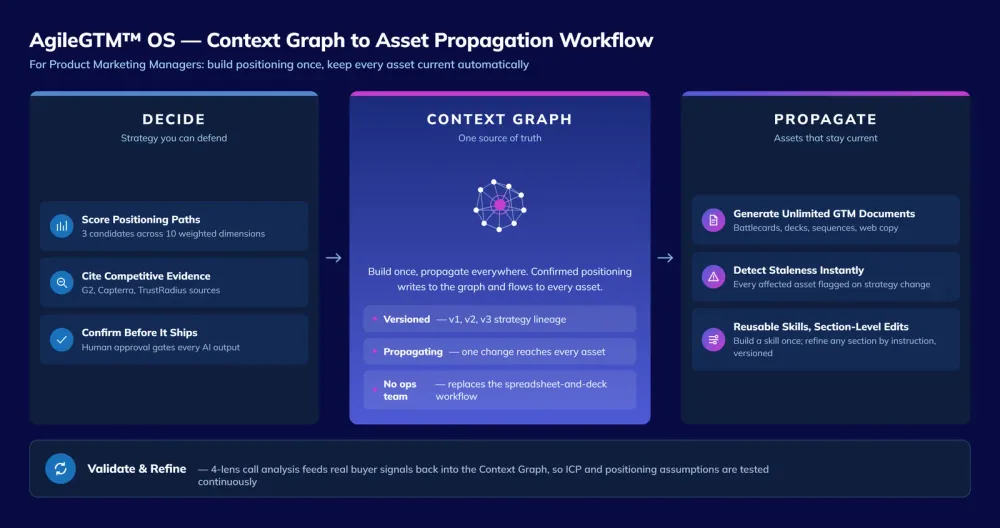
The approach
- Build once, propagate everywhere: Confirmed strategy decisions write to the Context Graph and flow to every downstream asset automatically.
- Score positioning paths before committing: Three candidate positions scored across 10 weighted dimensions — not a single AI guess.
- Ground competitive intelligence in cited evidence: Battlecards reference G2, Capterra, and TrustRadius sources reps can verify in the room.
- Detect staleness the moment strategy shifts: Every affected battlecard, email sequence, and sales deck is flagged and queued for bulk regeneration in one action.
- Validate ICP assumptions against real buyer calls: Four-lens call analysis feeds structured buyer signals back into the same Context Graph your strategy was built on.
- Govern AI outputs with human confirmation: Nothing writes to the shared knowledge base until you explicitly approve it — AI speed, human accountability.
- Generate unlimited GTM documents from one source of truth: Battlecards, sales decks, email sequences, and web copy all generated from the same versioned strategy data.
When a positioning decision is confirmed in the Context Graph, AgileGTM® OS automatically flags every downstream asset — battlecards, sequences, decks — as stale. PMMs can use pre-built skills or document skill builder to create unlimited GTM documents.
Key capabilities for Product Marketing Managers
AgileGTM® OS handles the research, versioning, and propagation work that consumes your week — so you can focus on the strategic synthesis that actually moves the business.
Competitive Intelligence That Stays Current
Profile and update competitors across 14 attributes, with gap analysis cited from review sites — so your battlecards never go stale.
Unlimited Strategy-Grounded Documents, Auto-Refreshed
Battlecards, one-pagers, sales decks, case studies, and email sequences are generated from the same strategy data — and flagged automatically when underlying strategy changes.
Know Exactly What to Close to Defend Your Position
Three strategic positioning options scored across 10 weighted dimensions — so you select the strongest path with evidence, not internal opinion. Once you commit, capability gaps are prioritized against what your target ICP actually expects, not guesswork.
Single Authoritative ICP — Shared Across Every Function
4–8 deduplicated market segments with scored ICP tiers feed Sales, Marketing, and Product from one confirmed source — ending the quarterly ICP debate for good.
Buyer Conversation Signals Validate Your Assumptions
Four-lens call analysis — Capability Demand, ICP Validation, Competitive Intelligence, Market Signals — keeps positioning grounded in what buyers actually say.
Human-Confirmed Strategy Before Anything Propagates
Nothing writes to the shared knowledge base until you explicitly confirm it — giving you full control over what reaches Sales, without slowing the workflow down.
Every capability feeds the same Context Graph, so a positioning update you confirm today automatically surfaces as a staleness flag on every downstream asset that needs updating.
What Product Marketing Manager teams achieve
AgileGTM® OS is built by operators who have lived the PMM capacity problem firsthand — running competitive intelligence, ICP governance, and content maintenance as a team of one. The platform's structured methodology, review-site-cited competitive profiling, and staleness detection are designed specifically to replace the manual overhead that consumes the majority of a PMM's week, freeing time for the high-leverage strategic work that actually moves the needle.
When your competitive knowledge base stays current and your positioning changes propagate automatically, you stop playing catch-up — and start driving the strategy your team actually executes against.
From zero to live pipeline in 4 steps
- 1
Define your market and ICP
AgileGTM® OS synthesizes 4–8 deduplicated market segments and generates 2–3 detailed buyer personas per segment — complete with pain points, buying triggers, and disqualifiers. Each ICP receives a priority tier score from 1–10 so you know exactly where to focus first.
- 2
Build your competitive and positioning foundation
AI agents profile competitors across 14 attributes, pulling cited evidence from G2, Capterra, and TrustRadius. From there, three strategic positioning paths are scored across 10 weighted dimensions — and a Positioning Brief is generated automatically, ready for stakeholder review.
- 3
Generate your GTM content and campaign playbooks
With your strategy confirmed in the Context Graph, AgileGTM® OS generates unlimited document types — battlecards, sales decks, one-pagers, email sequences, and more — all grounded in the same strategy data. Multi-channel campaign cadences are built from your ICP tiers and live account signals, so messaging is relevant from day one.
- 4
Launch pipeline and track readiness live
Integration with data providers like Apollo.io and other sources surfaces ICP-matched contacts with account-level buying signals — hiring, funding, M&A, and more — pre-loaded as outreach hooks. The GTM Strategy Readiness Dashboard tracks five live cross-functional signals so you can see what's working and what needs attention, without waiting for a quarterly review.
Time to value: Most Product Marketing Managers complete Steps 1–3 and have their first strategy-grounded assets ready for review within a single 7-day trial — no dedicated ops headcount required.
Once your foundation is live, AgileGTM® OS keeps working — flagging stale documents when strategy changes, surfacing new account signals, and updating your readiness scores as your market evolves.
Questions about AgileGTM® OS for Product Marketing Managers
How does AgileGTM® OS help a Product Marketing Manager maintain always-current competitive intelligence without manual research?
AgileGTM® OS automates competitive intelligence for PMMs by generating 14-attribute deep competitor profiles, with gap analysis that cites specific sources from G2, Capterra, and TrustRadius — not inferred weaknesses. Parallel competitor research runs in batches of three with real-time progress streaming, so you get a structured, evidence-backed competitive knowledge base without spending six hours a week on manual research.
Every profile writes into the Context Graph, AgileGTM® OS's versioned GTM knowledge base, so when a competitor moves, the staleness detection system flags every downstream asset — battlecards, one-pagers, email sequences — that needs updating. You stay current without rebuilding from scratch each time.
What results can a PMM expect from using AgileGTM® OS for competitive intelligence and go-to-market strategy?
AgileGTM® OS is designed to compress the most time-intensive parts of a PMM's workflow. The platform generates 14-attribute competitor profiles with cited review-site evidence, scores three strategic positioning paths across 10 weighted dimensions, and produces a Positioning Brief — work that typically takes days of manual research and stakeholder alignment. The Competitor Displacement Readiness signal on the GTM Strategy Readiness Dashboard gives you a per-competitor, evidence-backed advantage score you can share with sales without a separate deck.
For ICP definition, the platform synthesizes 4–8 market segments with 2–3 detailed buyer personas each, including buying triggers and disqualifiers, in a single workflow. That structured ICP definition then feeds directly into campaign playbook generation and pipeline prospecting — so the work you do in strategy actually propagates into execution rather than sitting in a Notion doc no one reads.
How does AgileGTM® OS integrate with the tools a PMM already uses, like Notion, HubSpot, and Gong?
AgileGTM® OS connects to call recording platforms for automatic transcript sync with speaker classification, so buyer conversation data flows into the platform without manual upload. For pipeline prospecting, it integrates with data providers like Apollo.io and others for B2B contact search using your ICP criteria. The platform exports documents in PDF, DOCX, HTML, and Markdown formats, which means battlecards, one-pagers, and sales decks can be dropped directly into your existing Notion workspace, Google Drive, or sent to sales through whatever channel they already use.
AgileGTM® OS is not designed to replace your CRM or marketing automation stack. It sits above those tools as a strategy layer — the single source of truth for ICP definition, positioning, and competitive intelligence — and pushes structured outputs downstream into the formats your team already works in. You don't need to migrate your content library to get value from day one.
I'm a team of one. I don't have time to implement and manage a new platform on top of my current workload — how does AgileGTM® OS actually reduce my work rather than add to it?
This is the right question to ask. AgileGTM® OS is built around a guided, sequential workflow where AI agents do the research and generation work — you confirm, refine, and approve. The Conversational AI layer lets you ask strategy questions grounded in your Context Graph at zero credit cost, and refine your GTM strategy steps through natural conversation — no need to manually edit each field. The goal is to get you from a positioning question to a client-ready output in hours, not days.
The staleness detection system is specifically designed for a PMM operating alone. When your strategy changes — a competitor moves, you update your ICP, or leadership shifts the positioning — the platform automatically flags every downstream document that's now out of date. Instead of auditing 15 assets manually, you see exactly what needs refreshing and can regenerate those sections without starting over. That's the compounding benefit: the more strategy you build in the platform, the less manual maintenance your content library requires.
I've tried AI tools for competitive research before and the outputs were too generic to use in real sales situations. How is AgileGTM® OS different?
Generic AI outputs happen when the tool has no structured context about your specific product, your ICP, or your competitive landscape. AgileGTM® OS grounds every output in the Context Graph — a versioned knowledge base that accumulates your confirmed strategy decisions across market segments, capability inventory, positioning paths, and pricing architecture. When the platform generates a battlecard or competitive displacement argument, it's pulling from your specific capability census, your ICP tier scores, and review-site-cited evidence about your competitors' documented weaknesses — not from a generic prompt.
The Competitor Displacement Readiness signal goes further: it produces a per-competitor, evidence-backed advantage score that references specific sources from G2, Capterra, and TrustRadius. Sales reps can see exactly where the evidence comes from, which is what makes them actually use the battlecard rather than dismiss it as marketing copy. If the competitive intelligence isn't sourced and cited, it won't get used — and AgileGTM® OS is built around that constraint.
How does AgileGTM® OS help a PMM establish a single authoritative ICP definition that Product, Marketing, and Sales all actually use?
AgileGTM® OS creates a structured, versioned ICP definition — 4–8 market segments with 2–3 detailed buyer personas each, including firmographics, buying triggers, disqualifiers, and ICP tier scores from 1–10 — and writes it into the Context Graph as the shared data layer for all downstream outputs. Because every campaign playbook, battlecard, pipeline search, and content document is computed from the same ICP definition, there's no longer a separate "marketing ICP doc" and a "sales ICP spreadsheet" drifting apart over time.
When the ICP definition changes — because buyer conversations surface new signals or leadership updates the target segment — the staleness detection system flags every downstream asset that was built on the old definition. That propagation mechanism is what makes the ICP definition authoritative rather than aspirational: it's not a document people agree to in a meeting and then ignore, it's the data layer that everything else is computed from.
How does AgileGTM® OS handle the human review and approval workflow before AI-generated strategy outputs reach sales or go live?
Human confirmation is a design constraint in AgileGTM® OS, not an optional setting. Nothing persists to the Context Graph — the shared strategy knowledge base — until you explicitly confirm it. Every strategy step requires your review and approval before the output becomes the foundation for downstream documents, campaign playbooks, or pipeline prospecting. This means AI-generated positioning, ICP definitions, and competitive profiles are always confirmed by a human before they propagate anywhere in the system.
For PMMs who need to demonstrate that AI outputs have been reviewed before reaching sales, the platform maintains an append-only audit trail. You can show exactly which strategy decisions were confirmed, when, and by whom — which is the kind of governance record that satisfies both internal stakeholders and, for teams moving upmarket, enterprise procurement reviews.
How is this different from just using Claude Code or Claude Cowork to generate strategy and content?
General-purpose AI tools like Claude Code or Claude Cowork are excellent at generating content, but they don't govern what becomes your canonical GTM strategy or keeps your content library in sync with it. AgileGTM® OS enforces a hard confirmation gate — no AI-generated ICP, positioning, or competitive profile becomes part of your strategy or reaches a battlecard until you explicitly approve it. Every confirmation is logged in an append-only audit trail showing who approved it and when, visible in a version history view — the kind of record that satisfies internal stakeholders and enterprise procurement reviews, not just a chat transcript.
Because every asset traces back to one Context Graph, a strategy change also automatically flags every downstream battlecard, sequence, and deck as stale, so as a team of one you're never manually auditing which assets fell out of sync. General AI tools govern how content gets generated; AgileGTM® OS additionally governs what becomes canonical strategy and what breaks when it changes.
Ready to ship positioning that actually sticks?
You've spent enough cycles chasing stale assets and realigning Sales on last quarter's messaging. AgileGTM® OS gives you one source of truth — and keeps every downstream asset current without the manual overhead.